
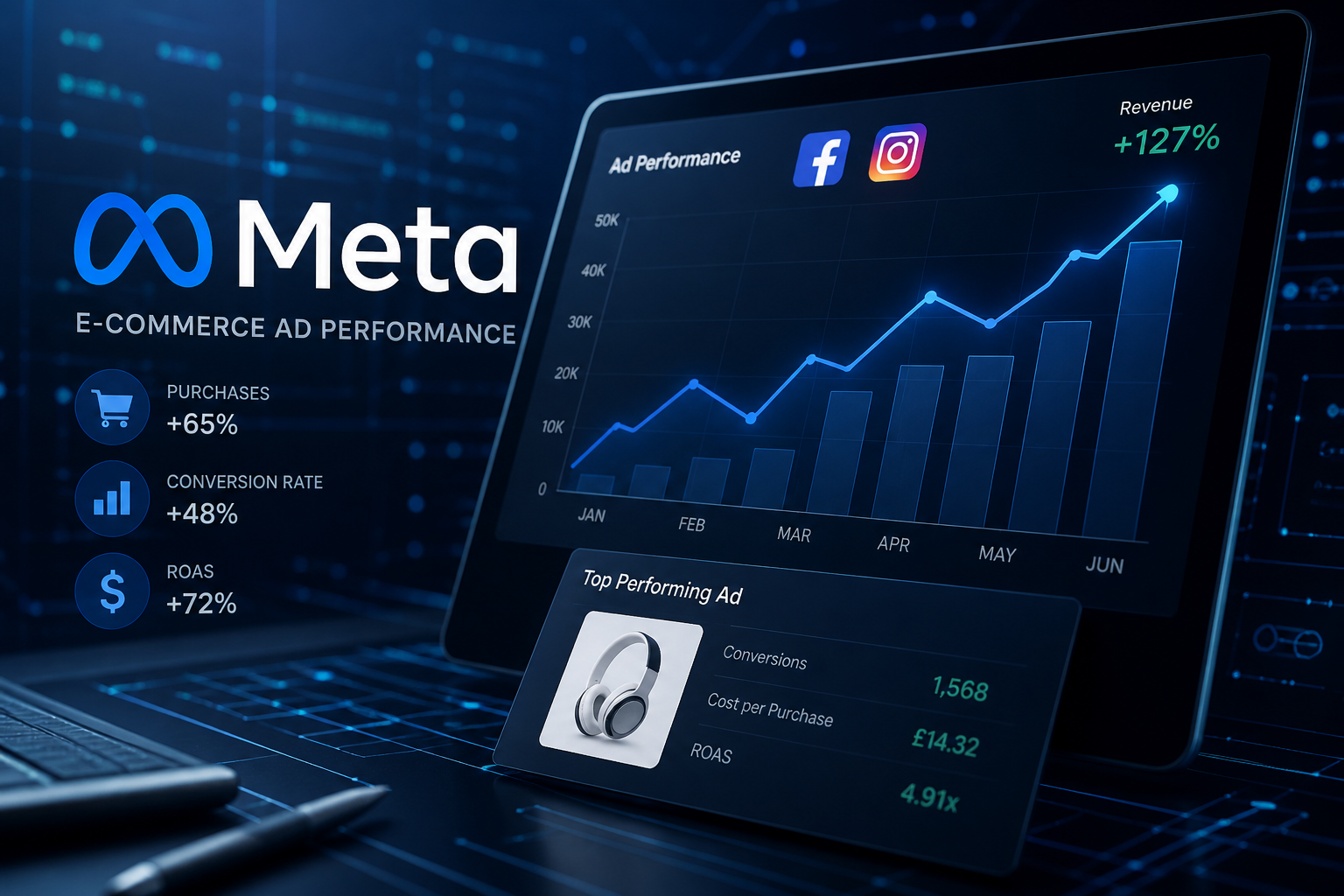
Meta advertising has become one of the most important growth channels for e-commerce businesses. With access to vast audiences across Facebook and Instagram, it offers brands the ability to generate consistent traffic, leads, and revenue at scale.
However, the way Meta ads perform has changed significantly in recent years. Where targeting and budget once played the dominant role, performance is now driven increasingly by creative and copy.
For e-commerce brands looking to improve conversion rates and return on ad spend, the focus needs to shift. Success on Meta is no longer just about reaching people. It is about capturing attention, communicating value clearly, and guiding users towards action in a matter of seconds.
This article explores how e-commerce businesses can improve Meta ad performance by focusing on creative, messaging, and structure, with practical insights that can be applied immediately.
Why Meta Ad Performance Now Depends on Creative
Meta’s advertising platform has evolved. With increased automation, broader targeting, and machine learning optimisation, advertisers have less control over who sees their ads. Instead, the algorithm relies heavily on engagement signals to determine which ads perform best.
This means creative has become the primary driver of performance.
If your ad captures attention, generates engagement, and leads to clicks or conversions, Meta will favour it. If it does not, performance will decline regardless of how well your campaigns are set up.
For e-commerce brands, this shift presents both a challenge and an opportunity.
The challenge is that average creative no longer works. The opportunity is that better creative can outperform competitors quickly, even with similar budgets.
The First Objective: Stop the Scroll
Every Meta ad has one immediate job: stop the user from scrolling.
Users move quickly through their feeds, often making split-second decisions about what to engage with. Your ad is competing not just with other advertisers, but with friends, influencers, news, and entertainment content.
To stand out, your creative must:
- Be visually distinctive
- Communicate relevance instantly
- Create enough curiosity or value to pause attention
This does not require complex design. In many cases, simple, well-structured creative performs better than highly polished assets because it feels more natural within the feed.
For e-commerce brands, this often means showing the product in context, highlighting a clear benefit, or presenting a relatable scenario that resonates with the target audience.
Clarity Is More Important Than Creativity
A common mistake in Meta advertising is overcomplicating the message.
High-performing ads are typically built around a single, clear idea. They answer one question effectively:
Why should someone care about this product right now?
Trying to communicate multiple benefits, features, and messages within one ad reduces clarity and weakens performance.
Instead, each ad should focus on:
- One key benefit
- One audience need or problem
- One clear action
For example, rather than listing multiple product features, an ad might focus on a single outcome, such as saving time, improving comfort, or solving a specific problem.
This level of clarity makes it easier for users to understand the value quickly, increasing the likelihood of engagement and conversion.
The Role of Copy in Meta Ad Performance
While visuals are critical for capturing attention, copy plays an equally important role in driving results.
Strong ad copy reinforces the message, builds interest, and encourages action. It should work seamlessly with the visual element, not compete with it.
Effective Meta ad copy for e-commerce typically includes:
- A strong opening line that hooks attention
- Clear, benefit-driven messaging
- Language that reflects the audience’s perspective
- A direct and relevant call to action
The opening line is particularly important. In many cases, this is what determines whether a user continues reading or scrolls past.
Copy should also feel natural and easy to read. Overly promotional or exaggerated language can reduce trust and make ads less effective.
Understanding Your Audience
Relevance is a key factor in Meta ad performance. The more relevant your ad is to your audience, the more likely it is to generate engagement and conversions.
For e-commerce brands, this means going beyond basic demographics and understanding:
- What motivates your customers to buy
- What problems they are trying to solve
- What objections they may have
- What outcomes they value most
These insights should inform both your creative and your messaging.
For example, a product might be positioned differently depending on whether the audience values convenience, quality, price, or status.
Ads that reflect real customer motivations tend to perform significantly better than generic campaigns.
Creative Formats That Work for E-commerce
Meta offers a range of ad formats, but not all perform equally for e-commerce brands.
Some of the most effective formats include:
Static Image Ads
Simple, clear product-focused images can perform well when paired with strong copy and a clear value proposition.
Video Ads
Video allows you to demonstrate products, show benefits in action, and tell a story. Short, engaging videos are particularly effective for capturing attention.
User-Generated Style Content
Content that feels authentic and relatable often performs strongly, especially when it resembles organic social content.
Carousel Ads
These allow you to showcase multiple products or highlight different features and benefits within a single ad.
The key is not to rely on a single format, but to test different approaches and identify what works best for your audience.
Testing and Iteration
There is no single formula for a perfect Meta ad. Performance comes from testing and refining creative over time.
E-commerce brands should regularly test variations of:
- Headlines
- Visuals
- Messaging angles
- Offers
- Calls to action
The goal is to identify patterns in what works and use those insights to improve future campaigns.
Testing should be structured and consistent. Rather than making multiple changes at once, it is more effective to test one variable at a time to understand its impact.
Over time, this approach leads to incremental improvements that can significantly increase overall performance.
The Link Between Creative and Conversion
Improving click-through rates is only part of the equation. For e-commerce brands, the ultimate goal is conversion.
This means ensuring that your ad creative aligns with the experience on your website or landing page.
Consistency is key. The message, tone, and value proposition in your ad should match what users see when they click through.
If there is a disconnect, users are more likely to drop off before converting.
Strong-performing brands ensure that:
- Ad messaging matches landing page messaging
- Visual style is consistent
- The offer is clearly presented and easy to understand
This alignment helps build trust and improves conversion rates.
Common Mistakes That Reduce Meta Ad Performance
Many e-commerce brands struggle with Meta ads not because the platform does not work, but because of common mistakes in execution.
These include:
- Using generic or unclear messaging
- Overloading ads with too much information
- Failing to test creative variations
- Ignoring audience insights
- Focusing too heavily on targeting rather than creative
Addressing these issues can often lead to immediate improvements in performance.
Why Creative Is Now a Competitive Advantage
As more e-commerce brands invest in Meta advertising, competition continues to increase.
This makes creative one of the most important differentiators.
Brands that invest in high-quality creative and copy are able to:
- Capture attention more effectively
- Engage their audience more consistently
- Improve conversion rates
- Achieve better return on ad spend
In contrast, brands that rely on average or repetitive creative often see declining performance over time.
Meta advertising remains a powerful channel for e-commerce growth, but the way it delivers results has changed.
Creative is now at the centre of performance.
For brands looking to improve results, the focus should be on creating clear, relevant, and engaging ads that connect with the audience and communicate value quickly.
By combining strong creative with a structured approach to testing and optimisation, e-commerce businesses can significantly improve Meta ad performance and drive more consistent revenue.
